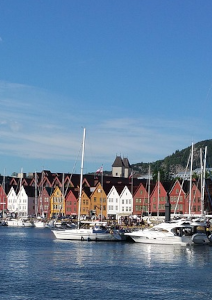
Last week, UZEI took part in two international events in Bergen (Norway) closely related to terminology and its development:
- The seminar marking the 30th anniversary of the European Association for Terminology (EAFT) and the 50th anniversary of Nordterm, entitled Linguistic Sustainability and Preparedness, held on 4 September.
- NeoTerm 2026, the second International Workshop on Terminological Neologism Management, organised by ENEOLI (European Network on Lexical Innovation), which took place the previous day.
Both events provided a valuable opportunity to share knowledge and experiences and, at the same time, to gain first-hand insight into the latest developments in terminology and terminological neologism management at European level.
Looking to the future without losing sight of our roots
The Anniversary Seminar, co-organised by EAFT, Nordterm, the Centre for Professional Language at the University of Bergen, Termportalen and Fagspråksenteret, brought together terminology colleagues from across Europe to share knowledge, experiences, perspectives and visions for the future. It was also a particularly meaningful opportunity to look back and reflect on the history of European terminology networks: some participants had been present when Nordterm and EAFT were founded and shared their first-hand memories of those early days.
For UZEI, being part of these collaborative networks is nothing new. Since its foundation 49 years ago, UZEI has been actively involved in European terminology networks and international cooperation initiatives. EAFT is particularly noteworthy in this respect. UZEI has been a member of EAFT since the association’s early days and has been represented on its Board since 2016; Begoña Arrate, a terminologist at UZEI, currently serves on the EAFT Board.
Among its main objectives, EAFT seeks to promote multilingualism through terminology, provide a European platform for promoting and professionalising terminological activities and raising awareness of them, and foster active cooperation with other relevant organisations, associations and institutions. These objectives are particularly closely aligned with UZEI’s history and work.
Almost five decades of building networks for Basque
This international trajectory is closely linked to some of the major milestones in Basque terminology. In 1987, UZEI created Euskalterm, the Basque terminology bank on which the current Basque Public Terminology Bank was subsequently built in 2001, becoming a key reference tool for the unification and standardisation of terminology in Basque.
In 2002, UZEI also signed the Brussels Declaration on international cooperation in terminology, endorsed by EAFT and a number of European terminology centres and organisations. UZEI was also the organisation that translated the declaration into Basque.
Participation in these networks has also helped to raise international awareness of both the work carried out in the field of Basque terminology and the commitment of Basque institutions to this area. UZEI has contributed to this through its participation in international conferences and presentations, and particularly through its organisation of the EAFT Terminology Summit 2018 in Donostia-San Sebastian. In this way, UZEI has helped to put Basque and Basque terminology on the international terminology map.
A network that extends beyond EAFT
UZEI’s international cooperation is not limited to EAFT. Throughout its history, it has maintained links with a range of specialised organisations and networks, including TermNet, International Network for Terminology, InfoTerm and the Spanish Association for Terminology (AETER), as well as agreements and close working relationships with other terminology organisations both in Spain and abroad.
This broad network of cooperation is rooted in a fundamental idea: in a field such as terminology, which is closely linked to the evolution of knowledge, sharing experiences and coordinating with other languages and linguistic communities makes it easier to address new challenges while also enriching our own work.
From terminology to neology: responding to the needs of a living language
This commitment to collaboration and exchange also extends to neology, a particularly relevant field in a context of constant lexical renewal and the emergence of new concepts and terms.
In 2023, UZEI created Neoloteka, an observatory dedicated to identifying, collecting, analysing and making available to everyone newly incorporated lexical forms in Basque. Through this initiative, UZEI is helping to address a gap that Basque had in comparison with other languages in its surrounding linguistic environment, where projects devoted to the collection and analysis of neologisms have existed for years, such as those developed for Catalan and Spanish.
International cooperation also plays an important role in this area. UZEI works on Neoloteka in collaboration with TERMCAT, the terminology centre of the Government of Catalonia, and with the DGLFLF (Délégation générale à la langue française et aux langues de France) of the French Government, with the aim of coordinating its work with other neology observatories working on the languages around us.
Sharing what we do and learning from others
This is where the value of UZEI’s presence in Bergen becomes clear. Taking part in these networks means sharing the experience UZEI has built up in the field of the Basque language and Basque terminology, raising awareness of the work carried out in Euskadi and, at the same time, staying in close contact with new trends, methodologies and challenges in the field. Attending NeoTerm 2026 provided an opportunity to explore one of these rapidly evolving areas in greater depth: the management of terminological neologisms.
UZEI’s presence in Bergen is therefore part of a history spanning almost five decades of international cooperation and engagement. This journey has helped to raise the profile of the terminology work carried out in Euskadi, to place the Basque language on the European and international terminology map, and to enrich UZEI’s own work through the knowledge and experience generated in other linguistic contexts.
Being part of these networks is not simply about representing the Basque language beyond our borders. It also means learning from other languages and communities, anticipating new challenges, and continuing to strengthen terminology and neology in Basque. This long-standing exchange is precisely one of the keys to ensuring that a language can continue to develop the resources it needs to respond to new areas of knowledge and communication.
As part of these efforts to promote the international presence of the Basque language, UZEI also receives support from Etxepare Euskal Institutua (Etxepare Basque Institute), whose work to promote the international presence and recognition of the Basque language and culture is fundamental. We would like to thank the Etxepare Institute for its support for UZEI and for its commitment to strengthening the international presence of the Basque language.